Auditions
Audition process
If you would like to audition for a Peridot production, please contact the Director. All contact information is provided in the Audition Notice. The format of the audition, whether by individual appointment or in a group, is at the discretion of the Director. If you are successful, it is a requirement that you must be available for all rehearsals and for the performance season. If unsuccessful, you are most welcome to seek feedback from the Director. Chookas for your audition!
Please note, our top priority is the health and safety of our members and patrons, so please join us in following public health advice at all times.
Audition Notice: Calendar Girls
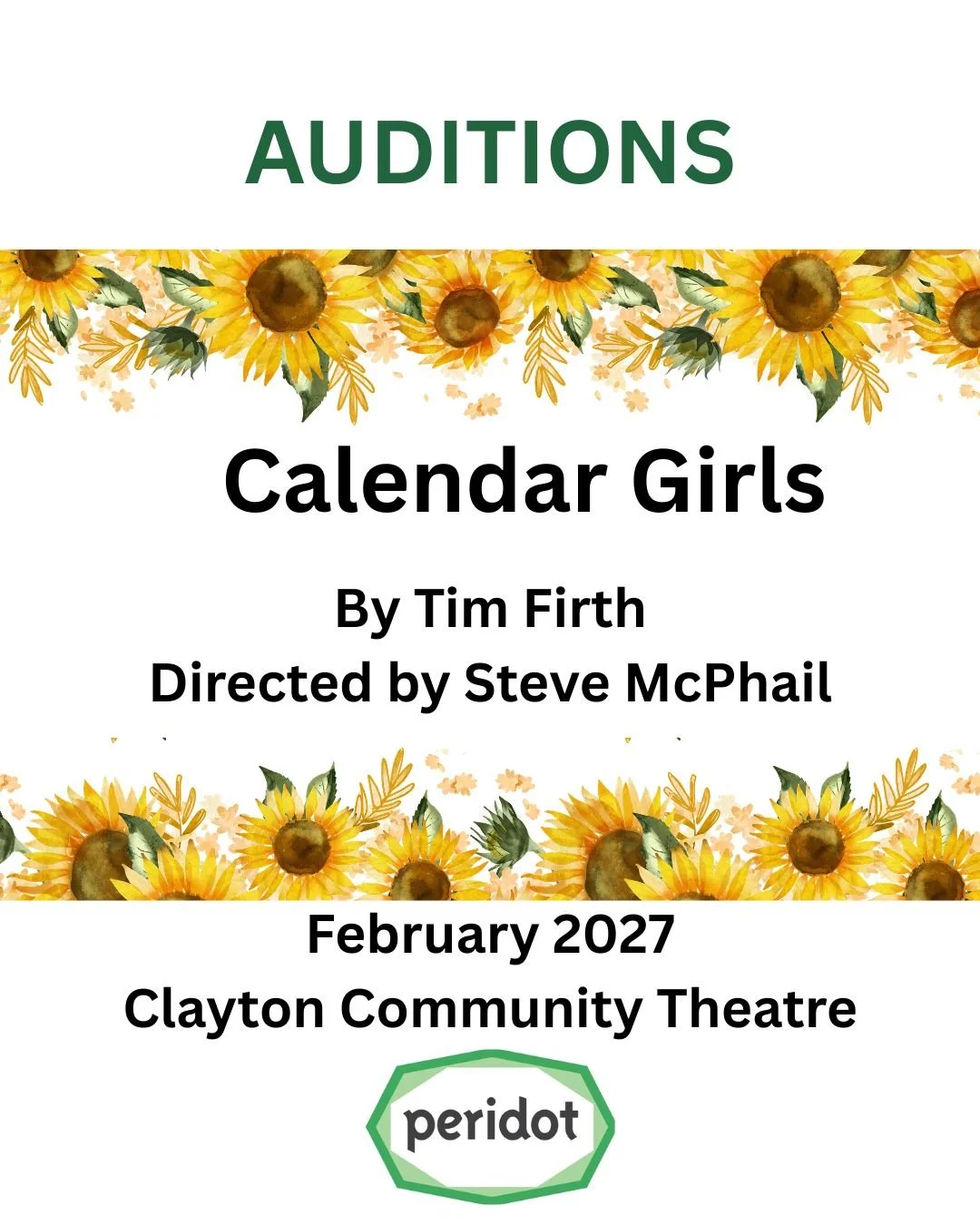
Peridot Theatre Company is pleased to announce auditions for our February 2027 production of Calendar Girls by Tim Firth.
Production Details
Director: Steve McPhail
Show Dates: February 18-28, 2027
Audition Dates & Times
Saturday, August 29: 1:00 pm – 5:30 pm
Monday, August 31: 5:00 pm – 9:00 pm
Tuesday, September 1: 5:00 pm – 9:00 pm
Wednesday, September 2: 6.00pm - 9.00pm - Callbacks if needed
Venue
Killester College, 433 Springvale road, Springvale, 3171 - enter via main entrance on Springvale Road.
Book your audition
Please contact Steve McPhail on stephen.mcphail@bigpond.com for more information regarding audition format and to book an audition. Similarly, Steve can be contacted on 0400 976 046 from 3.30pm - 9.30pm weekdays, or anytime on weekends.
Show Synopsis
Set in the Yorkshire village of Knapeley, Calendar Girls tells the uplifting story of love, loss, and female solidarity. When Annie’s husband John tragically dies of leukemia, her dynamic best friend Chris decides to raise funds in his memory to replace the uncomfortable settee in the hospital's relatives' waiting room.
Rather than producing another routine WI calendar of local bridges and churches, Chris convinces Annie and their fellow Women's Institute members to pose discreetly nude for an "Alternative WI Calendar". Artfully concealed behind traditional WI activities—such as baking, flower arranging, jam-making, and knitting—the group overcomes their initial bashfulness and pushes past the vocal objections of their rigid WI chairman, Marie.
What starts as a modest local campaign quickly turns into an extraordinary global media frenzy. As press attention, letters, and international recognition flood into their quiet village, the strong bonds of friendship between the women are put to the test as they learn to navigate grief, newfound fame, and self-acceptance.
Featured Characters Overview
Chris (50s): Loud, confident, and full of life; the charismatic driving force behind the calendar.
Annie (50s): Chris's loyal best friend; warm, grounded, and coping with the loss of her husband, John.
Cora (around 40): An ex-rock-chick, single mother, and church organist with a dry, deadpan wit.
Jessie (late 60s/70s): A former schoolteacher with a feisty, life-affirming spirit who refuses to be sidelined by age.
Celia (35–50): Glamorous, wealthy, and rebellious; at home in high-end fashion and eager to defy small-minded expectations.
Ruth (40s): Eager to please and initially hesitant, she discovers her genuine self-confidence along the way.
Marie (50s): The uptight, proud WI chairman who values traditional decorum above all else.
John (50s): Annie’s husband. He is a deeply loved, stoic, and incredibly warm village archetype. Facing a terminal leukemia diagnosis, he maintains a gentle, poetic perspective on life and a refusal to let sadness dictate his remaining days.
Rod (40/50’s): Chris’s husband. He is a hardworking, practical, and incredibly patient man who runs the local flower/fruit shop. He loves Chris's wild energy but acts as the realist who gets left behind when the calendar goes viral.
Lady Cravenshire (60s–70s): The grand, aristocratic patron of the local W.I. chapter. She embodies old-money privilege, effortless intimidation, and passive-aggressive upper-class manners.
Elaine (20s): A young, patronising beautician who views the older WI members as if they come from another world. Though condescending, she does not mean to be malicious.
Lawrence (20’s-30’s): The young, professional, and increasingly flustered local photographer tasked with shooting the calendar. He is a gentleman, desperately trying to maintain artistic integrity while being completely overwhelmed by a room full of naked middle-aged women.
Liam (20’s - 30’s): Liam is a director who finds himself hired to manage a commercial photoshoot for washing detergent. He harbors higher creative ambitions and would much rather be directing other, higher-profile projects than washing powder commercials.
Brenda Hulse, 50’s: Brenda is a guest speaker that does the rounds to WI’s across northern England. She speaks on such interesting topics as “Broccoli” and “The history of the Tea Towel”.
Lawrence/Liam may be played by the same actor.
Brenda Hulse/Lady Cravenshire may be played by the same actor.
Audition Format:
All auditions will be in 20 minute timeslots.
Accents
The women of the real calendar in truth came from many parts of the country. Actors should resist the pressure to perform any kind of Yorkshire pyrotechnics. Nothing compromises the truth of comedy like a slavish attention to vowel-sounds and diphthongs. It will become a pebble in the shoe. If you can flatten the "a" so that giraffe no longer rhymes with scarf then that will be more than sufficient; but even that should not be championed over the intrinsic rhythm of the line. People travel. Communities are now gloriously multi-instrumental. We've had accents from Glasgow to Texas make the same part their own.
Characters
Chris, 50s
You want Chris at your party. She will talk to people she doesn't know, find things to say to fill silences and generate laughter. Part of this is because Chris is at home in crowds, holding court, being the centre of attention. Without Chris in her life, Annie would be better behaved, her life less fun. The two of them are like naughty schoolgirls. Ideal car -who cares, as long as it's a cabriolet. Ideal holiday -Algarve.
The Character: The engine of the play. She is rebellious, charismatic, fiercely loyal, and funny—but can become blind to other people's feelings when she gets a big idea.
The Audition Context: Chris is trying to convince the reluctant W.I. women to move forward with the alternative calendar. She has to balance humor with a genuine spark of inspiration.
The Audition Piece: "Look at us. Just look at us! We are sitting here arguing about the legality of a tea cozy while outside this hall, the world is actually turning. I love John. You love John. And right now, John is dying in a hospital bed surrounded by beige walls and a view of a car park. If we make a traditional calendar, we raise fifty quid. Fifty quid buys a couple of nice pillows. If we do this—if we do something that actually makes people sit up and look—we might raise enough to replace that whole bloody waiting room. Yes, it’s naked. Yes, my mother will probably have a stroke. But it’s not dirty, is it? It’s... it’s Yorkshire. It’s flesh and baking and apples and us. If we don't do something brave now, when the hell are we ever going to do it?"
Script piece to prepare:p66-67, p107-9 and/or 115-16 (at least two).
Annie, 50s
Annie will join in mischief but is at heart more conformist and less confrontational than Chris. After Chris has put a waiter's back up in the restaurant, Annie will go in and pour calm. The mischievousness Chris elicits saves Annie from being a saint. She has enough edge to be interesting, and enough salt not to be too sweet. Ideal car -who cares, 'as long as it's reliable. Ideal holiday -walking in English countryside
Together these two are greater than the sum of their parts. They would be lesser humans had they not met each other. Each is spiritual mustard to the other's meat.
The Character: Chris's best friend and John’s wife. She is the emotional anchor of the show. She possesses a quiet, dignified strength and a dry, warm sense of humor that is currently masked by profound grief.
The Audition Context: Annie is speaking shortly after John's passing, reflecting on his unique philosophy on life and his love for sunflowers.
The Audition Piece: "John used to buy these seeds by the sackful. He’d say to me, 'Annie, the sunflower is a very wonderful thing.' And I’d say, 'John, it’s a giant weed with an identity crisis.' But he insisted. He said that the flower always follows the sun. That even on the darkest, greyest Yorkshire days, it finds the light. He used to say that the final stage of a flower’s life is always the most beautiful because that’s when it drops its seeds to make sure something else grows. I didn’t understand what he meant then. I just thought he was being poetic because he didn't want to do the weeding. But looking at these seeds now... I realize he knew. He knew he wasn't going to see them bloom this summer. He left them for me. For us. To remind us to keep looking up."
Script piece to prepare:p107-9 and/or 115-16, p14-15, and/or p35-36 (at least two).
Cora, around 40
Cora's past is the most eclectic, her horizons broadened by having gone to college. This caused a tectonic shift with her more parochial parents. She came back to them pregnant and tail-between-legs, but Cora has too much native resilience to be downtrodden. She is the joker in the pack, but never plays the fool. Her wit is deadpan. It raises laughter in others, but rarely in herself. Her relationship with her daughter is more akin to that between Chris and Annie. Cora doesn't need to sing like a diva but must be able to sing well enough to start the show with Jerusalem and sing the snatches of other songs required. The piano keyboard can be marked up to enable her to play basic chords should she not be a player. Ideal car -who cares, as long as the sound system is loud. Ideal holiday -New York.
The Character: The bohemian, music-loving vicar's daughter and a fiercely protective single mother. She is slightly edgy, plays the piano with a rock-and-roll soul, and possesses a cynical but deeply loyal disposition.
The Audition Context: Cora is reflecting on the irony of being the vicar's daughter participating in a nude calendar, balancing her irreverence with her deep love for the church community.
The Audition Piece: "You think my dad’s going to have a fit? Please. He’s a vicar in a Yorkshire parish; he’s seen things that would turn your hair white. Growing up in the vicarage, everyone expects you to be this perfect little angel who plays the organ and bakes flawless scones. But I’ve always been the girl who played the chords a bit too loud and wore too much eyeliner. This calendar isn't dirty. If my dad taught me anything about God, it’s that He’s got a sense of humor and He cares about what's in your heart, not whether you’re wearing a brassiere behind a rolling piano. We’re doing this for John. And if the parish council doesn't like it, they can find someone else to play the postlude on Sunday morning."
Script piece to prepare:p56-57 and p74-75.
Jessie, late 60s/70s
Get on the right side of Jessie as a teacher and she'll be the teacher you remember for life. Get on the wrong side and you will regret every waking hour. A lover of life, Jessie doesn't bother with cosmetics -her elixir of life is bravery. Jessie goes on rollercoasters. Her husband has been with her for a long time and is rarely surprised by her actions. Jessie bothers about grammar and will correct stallholders regarding their abuse of the apostrophe "s". Ideal car -strange-looking European thing which is no longer manufactured. Ideal holiday -walking in Switzerland or Angkor Wat.
The Character: A retired schoolteacher. She is sharp-witted, dry, entirely unapologetic about her age, and possesses a zero-tolerance policy for self-pity or pretension.
The Audition Context: Jessie is addressing the younger women who are stressing about their bodies and their ages before the photo shoot.
The Audition Piece: "Oh, grow up, the lot of you. 'Oh, my thighs, oh, my upper arms, oh, look at my chin!' Do you honestly think the people buying this calendar are going to be looking at your cellulite with a magnifying glass? At my age, every day above ground is a bonus. When you hit seventy, you realize that your body isn't an ornament anymore—it’s just the vehicle that gets you from the bed to the kettle. I taught teenagers for thirty-five years, and let me tell you, there is nothing an audience of middle-aged women can do that can scare me. If we are going to take our clothes off for Leukaemia research, then let's bloody well get on with it before my knees give out entirely. Pass me the knitting wool and let's start counting the stitches."
Script piece to prepare:p25-26 and p46-47.
Celia, age anything 35-50
The fact that Celia is in the WI is the greatest justification of its existence. A woman more at home in a department store than a church hall, she may be slightly younger than Chris or the same age, but she always feels like she's drifted in from another world. Which she has. She is particularly enamoured of Jessie, and despite the fact Jessie has very little time for most Celia's of this world, there is a rebelliousness in Celia to which Jessie responds. It's what sets Celia apart from the vapid materialism of her peer group and made her defect. Ideal car -Porsche, which she has. Ideal holiday - Maldives, where she often goes.
The Character: Glamorous, wealthy, and an outsider to the traditional village hierarchy. Married to an affluent doctor, she uses high fashion and a cheeky, unfiltered attitude as armor against the judgmental "golf club wives" who look down on her.
The Audition Context: Celia is explaining to the group why she is more than eager to strip off for the calendar, unleashing her frustration at the country-club culture.
The Audition Piece: "They look at me at the golf club and they think they’ve got me entirely figured out. 'Oh, look, it’s Celia. The second wife with the expensive highlights and the sports car.' They sit there in their twinsets and pearls, sipping dry sherry, judging my cleavage and talking about charity like it’s a competitive sport. They think because I’ve got a bit of money and a bit of silicon that I don't have a soul. Well, I want to do this calendar, Chris. I want to do it specifically because it will make those tight-faced old cows choke on their gin and tonics. I want them to see that a woman can be attractive, she can be un-stuffy, and she can still care about something real. So yes, let’s bring on the baked goods. I’ve been looking for an excuse to shock this village for five years."
Script piece to prepare: p29-30 and p86-88.
Ruth, 40s
Ruth's journey is from the false self-confidence of the emotionally abused to the genuine self confidence of the woman happy in her own skin. Ruth is eager to please but not a rag doll, and despite being Marie's right-hand woman she is desperate to be the cartilage in the spine of the WI and keep everyone happy. She has spine herself -if she was too wet, no-one would want her around. But they do, and they feel protective of her because they sense there is something better in Ruth than her life is letting out. They are proved right. Ideal car -at the start, whatever Eddie wants; at the end, whatever she wants. Ideal holiday -at the start wherever Eddie is, at the end wherever he isn't. The Rabbit Costume: Ruth made this last night. It should be a cocktail of good intention and not enough time.
The Character: The "mouse" of the group who eventually roars. She is traditionally anxious, desperately eager to please the conservative W.I. leader Marie, and handles her crumbling marriage by staying pathologically busy.
The Audition Context: Late in Act 2, after dealing with the stress of their sudden fame and discovering her husband's infidelity, Ruth finally snaps and lets out her bottled-up resentment.
The Audition Piece: "I know exactly what you all think of me. 'Good old Ruth. Quiet little Ruth. The one who cleans up the crumbs after the meeting and never says a word.' Well, let me tell you something—I am sick to death of being 'good old Ruth.' I did the calendar because for the first time in my miserable life, I felt like I was part of a pack. I felt brave! And yes, I know Eddie is cheating on me. I’m not stupid. I’ve known for months. I just thought if I made enough jam, or knitted enough squares, or smiled hard enough, it would somehow make it not true. But it is true. And I am done hiding behind the victoria sponges. If I want to drink vodka out of a plastic cup at two o'clock in the afternoon, I will bloody well do it!"
Script piece to prepare: p79-81 and p88-89.
Marie, 50s
Marie has gradually built the current 'Marie' around herself over the years as a defence mechanism. She went to her Oz, Cheshire, and found Oz didn't want her. She came back scorched. The WI is a trophy to her, which justifies her entire· existence. There is a lingering part of Marie that would love to be on that calendar. Ideal car -something German and well-valeted. Ideal holiday -a quasi-academic tour of somewhere in Persia advertised in a Sunday Supplement which she could then interminably bang on about.
The Character: The glamorous, deeply traditional, and rigid president of the Knapely W.I. She treats the institution like a personal fiefdom and views the calendar as an absolute vulgarity.
The Audition Context: Marie is confronting the women about the rumors of the alternative calendar, attempting to reassert her absolute authority.
The Audition Piece: "The Women’s Institute is not a joke, Christine. It is an institution built on dignity, craft, and community values. It has survived world wars, economic collapse, and the introduction of instant gravy, and it has done so because we adhere to a standard. My mother did not spend forty years perfecting her lemon curd just so this branch could become a laughingstock in the local gazette. A calendar featuring the women of Knapely without their brassieres is not 'artistic fundraising.' It is exhibitionism. If we allow this, what is next? Pole dancing in the church hall? Strip poker at the autumn fayre? There is a right way to do things, and there is a wrong way. And as long as I am holding this gavel, we will do things the proper way."
Script piece to prepare:p4-6, p19-21 and 79-81.
John, Annie's husband, 50s
John is a human sunflower. Not a saint. Not a hero. Just the kind of man you'd want in your car when crossing America. When he dies it feels like someone somewhere turned a light off.
The Character: Annie’s husband. He is a deeply loved, stoic, and incredibly warm village archetype. Facing a terminal leukemia diagnosis, he maintains a gentle, poetic perspective on life and a refusal to let sadness dictate his remaining days.
The Audition Context: John is addressing the W.I. ladies early in the play, presenting them with a gift of sunflower seeds and sharing his simple, moving philosophy.
The Audition Piece: "I know you ladies think I’m a bit obsessed with these flowers. But look at them. Really look at them. The sunflower is a very strange beast, you know. It spends its entire life chasing the light. Even on a miserable, rainy Yorkshire Tuesday, it’ll twist its neck right round just to find a single crack in the clouds. And then, right at the very end of its life, when it’s at its ugliest and most withered, that’s when it does something remarkable. It drops its seeds. It gives up everything it has left to make sure that the next generation gets a chance to bloom. We aren't here forever, girls. We’re only here for a season. So you’ve got to make sure you chase the sun while you can. Keep looking up."
Script piece to prepare: p14-15, p35-36.
Rod, Chris's husband, 50s
You have to be a certain kind of guy to stick with Chris and Rod loves it. He can give back what he gets, and has a deadpan humour which has always made Chris laugh. He drinks a lot but never so much as to have a problem. He would work every hour to make his shop a success. And John was his mate, even though the relationship waS originally channelled through their wives.
The Character: Chris’s husband. He is a hardworking, practical, and incredibly patient man who runs the local flower/fruit shop. He loves Chris's wild energy but acts as the realist who gets left behind when the calendar goes viral.
The Audition Context: In Act 2, Rod finally confronts Chris about how her obsession with global media and Hollywood fame is destroying their marriage and their local life.
The Audition Piece: "When did this stop being about John, Chris? Just tell me that. Because from where I’m standing, it looks like it’s entirely about you now. I’ve sat back and I’ve watched you run ragged for months, and I didn't say a word because I knew you were grieving. But the shop is falling apart. I missed our anniversary because you were on the phone to a morning talk show in New York. You’re so busy being the famous, rebellious Chris who took her clothes off that you’ve forgotten how to just be my wife. Annie is hurting. The girls are exhausted. We didn't do this to become celebrities, Chris. We did it to buy a bloody couch for a hospital. Come home. Please. Just... come back down to earth."
Script piece to prepare:p26-27 and p93-96.
Lawrence, late 20s
Hesitant without being nerdy, Lawrence is a shy young man with enough wit to make a joke and enough spirit to turn up at the WI hall in the first place. When he arranges the shots he is close to female nudity but sees only the photo.
The Character: The young, professional, and increasingly flustered local photographer tasked with shooting the calendar. He is a gentleman, desperately trying to maintain artistic integrity while being completely overwhelmed by a room full of naked middle-aged women.
The Audition Context: Liam is attempting to direct the chaotic photo shoot, trying to keep his eyes strictly on his camera equipment while giving instructions.
The Audition Piece: "Ladies—please, if I could just have a shred of professional silence for one moment! I am an artist. I have a degree in photographic arts from Leeds. I usually shoot landscapes and historical architecture. I am entirely prepared to treat this with the utmost aesthetic dignity. However, I cannot do that if you, Celia, keep adjusting the cake stand, or if you, Chris, keep waving those buns around like pom-poms. I need everyone to take a deep breath. When I count to three, I need you to drop the robes, hide behind the designated baked goods, and look at the lens like you’re thinking about... I don't know, a very nice cup of tea. Please don't look at me. Look at the camera. My eyes are shut, I promise you, my eyes are entirely shut until the shutter clicks!"
Script piece to prepare:p43-45 and p56-59.
Lady Cravenshire, 60s
Lady Cravenshire really doesn't mean to be so patronizing. But the WI girls seem from another world. The world of her estate workers. Dress: when she makes an entrance, she must make an entrance. Largely white or cream to outplay the others, with a bigger hat than Marie. She is not a tweed-wearer. She must glide in like a galleon.
The Character: The grand, aristocratic patron of the local W.I. chapter. She embodies old-money privilege, effortless intimidation, and passive-aggressive upper-class manners.
The Audition Context: She is judging the local W.I. baking and craft competition, doling out backhanded compliments with absolute, smiling authority.
The Audition Piece: "Well. It has certainly been a... spirited competition this year. Marie, your organization is, as always, pathologically precise. Now, looking at the sponge entries... Miss Jessie, your Victoria sandwich had an excellent rise, though I did detect a rather adventurous hand with the baking powder. It was a bit like eating a very polite sponge cloud. And Christine... your lemon curd. It is always an experience, isn't it? It has a certain... aggressive hostility to it that catches one right at the back of the throat. Quite unforgettable. However, the prize this year must go to Annie, for a preserve that reminds us that tradition, when handled with appropriate restraint, is always the highest virtue. Well done, dear. Let’s move on to the knitted garments, shall we?"
Script piece to prepare:p32-35.
Elaine, 20s
Elaine really doesn't mean to be so patronizing. But Jessie seems from another world. The world of her gran. Dress: her clinical whites slice rough like a knife. You feel you could cut yourself on that dress.
Script piece to prepare:p97-99.
Liam, late 20s
Liam would like to be directing other things than photoshoots for washing powders. He's not so unprofessional as to let it show, but we can sense a slight weariness at having to deal with these women. There's a resigned patience to his actions and each smile he makes we feel is professional. For Liam, this photoshoot is a job. And not the job he wanted. Dress: Avoid wearing shades inside a building. If you've gone down that route, you've made the weary boy a wideboy.
Script piece to prepare:p104-107.
Brenda Hulse, 50’s
Brenda is a guest speaker that does the rounds to WI’s across northern England. She speaks on such interesting topics as “Broccoli” and “The history of the Tea Towel”.
Script piece to prepare:p5-8.
Lawrence/Liam may be played by the same actor.
Brenda Hulse/Lady Cravenshire may be played by the same actor.